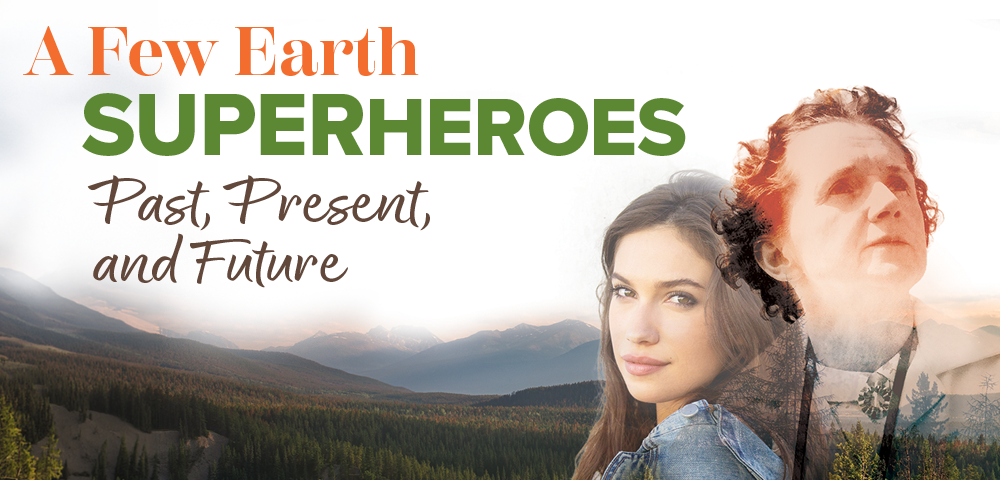
We all can become superheroes for our planet
RACHEL CARSON
She is a monumental figure in environmental activism, earning her a top spot on our list. Known for her groundbreaking work, especially her book Silent Spring, she exposed the harmful effects of dichlorodiphenyltrichloroethane (DDT) and sounded the alarm about its widespread use. Carson’s compelling storytelling not only revealed the risks of chemical pesticides, but it also sparked an entire movement that eventually led to the banning of DDT in the United States. Her passionate advocacy makes her a true champion of the Earth, highlighting the deep connection between humanity and nature. Through her timeless work, she inspired generations to see their responsibility to protect and preserve the fragile balance of our ecosystem. Her legacy continues to have a strong influence on today’s environmental discussions.
“Carson eloquently argued that human health is closely linked to the planet’s well-being, urging society to consider the impacts of environmental harm.”
YVON CHOUINARD
His name is far less known than that of his company, Patagonia. He’s a man who didn’t set his cap on a business career; far from it. He was a surfer and mountain climber who found a niche in creating clothing and gear for people who love spending time in the outdoors. In 2022, Chouinard, the visionary founder of Patagonia, made waves by transferring ownership of his $3 billion company to a trust and a nonprofit organization. This bold move ensures that all future profits – approximately $100 million annually – will be directed toward combating climate change and preserving our planet, rather than being reinvested in the business or distributed to shareholders. By doing so, Chouinard has made the Earth his most important stakeholder, underscoring his unwavering dedication to environmentalism over personal wealth.
“Fundamentally, businesses are responsible to their resource base. Without a healthy environment, there are no shareholders, no employees, no customers, and no business.”
– Yvon Chouinard, founder of Patagonia
JANE GOODALL
The late Jane Goodall first gained recognition for her passionate and empathetic advocacy for primates and primate research. Over the decades, she demonstrated that the chimpanzees she studied in Tanzania share many traits with humans, including the ability to use tools, experience complex emotions, form lasting social bonds, engage in organized warfare, and pass down knowledge from one generation to the next. Goodall then expanded her platform and leveraged her popularity to encourage global activism and sustainable living, making her an inspirational household name. One of her many messages of advice to world citizens is to connect with nature, reduce consumption, and adopt a plant-based diet.
“You cannot get through a single day without having an impact on the world around you. What you do makes a difference, and you have to decide what kind of difference you want to make.”
– Jane Goodall
DAVID ATTENBOROUGH
When you hear someone speak of David Attenborough, it’s likely you also hear his familiar voice as a television narrator, having helmed many natural history documentaries dating back to 1954. As the National Public Radio (NPR) once said of the man, Attenborough has “roamed the globe and shared his discoveries and enthusiasms” in “his patented semi-whisper.” However, at nearly 100 years of age, the focus of his work is increasingly environmental – supporting planetary biodiversity, limiting population growth, developing renewable sources of energy, mitigating climate change, reducing meat consumption, and preserving more of the world’s remaining natural areas.
“What humans do over the next 50 years will determine the fate of all life on the planet.”
– David Attenborough
ALICE WATERS
Chef Alice Waters has been an environmental hero since founding Chez Panisse in Berkeley, California, one of the original farm-to-table restaurants, helping to start a movement in 1971. She has been a champion of local, sustainable agriculture for over five decades. Her accolades and awards are too numerous to mention, but a few notable ones are listed below. In 1995, she founded The Edible Schoolyard Project, which advocates for a free, regenerative, and organic school lunch for all children, as well as a sustainable food curriculum in every public school. In 2015, she was awarded the National Humanities Medal by President Obama, demonstrating that eating is a political act and that the table is a powerful means of advancing social justice and positive change. Waters is the author of 16 books, including New York Times bestsellers The Art of Simple Food I & II, Edible Schoolyard: A Universal Idea, and a memoir, Coming to My Senses: The Making of a Counterculture Cook. Her newest book is We Are What We Eat: A Slow Food Manifesto.
“I think America’s food culture is embedded in fast-food culture. And the real question that we have is: How are we going to teach slow-food values in a fast-food world? Of course, it’s very, very difficult to do, especially when children have grown up eating fast food and the values that go with that.”
– Alice Waters
FUTURE EARTH SUPERHEROES
RACHEL PARENT
She is an environmental and safe food activist and speaker. Her passions include social justice, animal rights, responsible food consumption, and environmental protection. For the past 15 years, she has been a strong advocate for mandatory labeling of genetically modified organisms (GMOs) in our food, improving food system transparency, and increasing environmental protections. At age 12, Parent founded Kids Right to Know, a not-for-profit organization dedicated to educating youth about food safety and healthier food choices, challenging them to claim their right to know what’s in their food, and demanding GMO labeling in Canada.
“Young people are growing up in the shadow of climate change (or as I often call it, climate pollution)… [and] we all have a part to play in the solutions as well.”
– Rachel Parent
AUBE GIROUX
She is a documentary filmmaker, writer, and passionate organic gardener whose work centers on social justice and environmental sustainability. Her award-winning feature documentary Modified follows Giroux and her mother on a deeply personal investigation into why corporate interests are often placed above human well- being in our food policies. The film received numerous honors, including the 2019 James Beard Award for Best Documentary. Her popular farm-to-table cooking series on PBS, Kitchen Vignettes, connects the dots between good land stewardship and the recipes we make in our kitchens. The series received Saveur Magazine’s 2012 Best Food Blog Award and is a two-time James Beard Award nominee.
“The struggles for social justice, a healthy planet, and good food for all are inseparable – each depends on putting people before profit.”
– Aube Giroux